Archive for the 'Sailboat Racing' Category

Feb 08 2010

Bring It ON–The America’s Cup

Published by Tim under Boats,Sailboat Racing

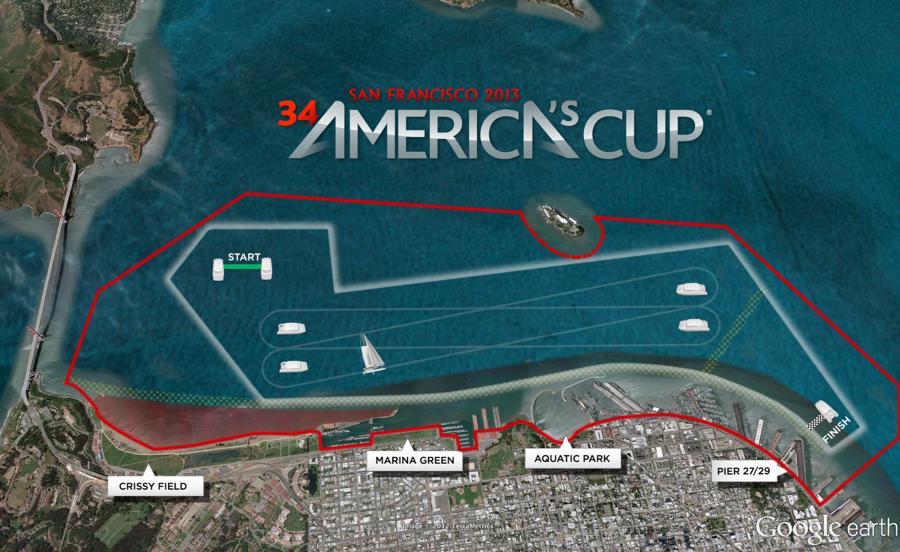
This was a big weekend for sports. There was, of course, the mother of all football games–the Superbowl. For sailing fans, however, the mother of all sailboat match racing, the America’s Cup, was at **GASP** 1am this morning.

Here is the shortened version of what has happened since the last event:

The Swiss team, Alinghi and owner, Ernesto Barterelli, beat New Zealand, and won the last America’s Cup. It was tight racing the whole series, and a real nail-biter with New Zealand beating the US team, BMW-Oracle (owner Larry Ellison), and then Alinghi beating NZ.

Of course, I was rooting for BMW-Oracle. They are based out of the Golden Gate Yacht Club in San Francisco–a venue that has hosted many races in San Francisco and has a great, non-stuffy sailor bar . . . so, I’m a fan.

Immediately after Alinghi won (seriously, within minutes), a fake yacht club owned by Ernesto Barterelli, filed a formal challenge–beating BMW-Oracle to become the challenger of record. The rules for the America’s Cup state that the Defending Team and the Challenger of Record must agree on the rules. The owner of Alinghi, Ernesto Barterelli, owned both teams, all the officials, and the rules went crazy in favor of him winning and keeping the Cup. (Stuff like, EB can change the rules at any time. EB can dismiss any team from the competition for no reason at all at any time. Anyone who used to be on the Alinghi team is not allowed to sail for any other team in the competition–meaning Russel Coutts.)

There has been something like 11 lawsuits, and 3.5 years, and all sorts of politics around the AC. At the end of it, Golden Gate Yacht Club was able to wrestle the Challenger of Record title away from Ernesto Barterelli, but what they got was a two-team match–not the 18 team match-racing that we all wanted.

The two teams agreed upon a unique set of rules for the boats. They are racing 90 foot by 90 foot multi-hull boats. That’s right–90′x90′. Alighi is fielding a giant Catamaran with traditional sails . . . and, BMW-Oracle produced a trimaran with a 185-foot standing vertical wing. Yes–a WING. The speed tests for the BMW-Oracle had it clocked doing 25 knots in 7 knots of wind. Uhmmm . . . . Yeah.

The rules are still pretty skewed. Supposedly, the Alinghi boat performs better in light wind, and the BMW-Oracle boat will be a killer in heavy wind, but doesn’t do so well in the light stuff. But, those are supposeds–no one really knows.

And, getting a race off is going to be tough. The sailing instructions say no sailing in winds above 15 knots, the Race Committee can call the race if the wind shifts more than 30 degrees, no racing is the swell is more than a meter high, and there is obviously no racing if there is not enough wind. This is a tough set of conditions to meet in Valencia, where the winds are shifty.

Personally, I want to see the boats race and hold together or blow-up, be a close race, or a blow out, or whatever they are going to do. The suspense is KILLING me.

The races today were cancelled. Not enough wind. So, they will try again on Wednesday at **GASP** 1am, again . . . .

  • Share/Bookmark

No responses yet

Feb 05 2010

My Kind of Fun: Dinghies Racing 25 NM in the Open Ocean

Published by Tim under Sailboat Racing

This is my kind of fun . . . .

  • Share/Bookmark

No responses yet

Feb 03 2010

BMW-Oracle Training–Final Days Before the America’s Cup

Published by Tim under Boats,Sailboat Racing

This has to be just about the most beautiful thing on the planet. BMW-Oracle’s monster Trimaran racing along on one hull. Truly a thing of beauty . . . .

We are 5 days away. Racing will be about 1am on Sunday . . . .

  • Share/Bookmark

No responses yet

Dec 01 2009

Racing Towards Bahia Santa Maria

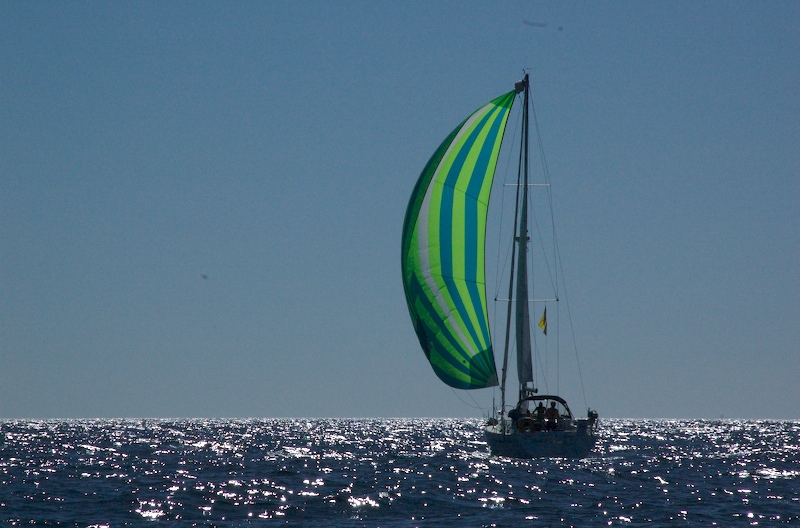
Another Baja Ha-ha racer flying a Spinnaker Somewhere during our first leg of the trip, we had forgotten that this was a race. We had started joking that “we are cruisers now,” and as we would collectively make decisions, we would posit, “Are we thinking like racers or cruisers?”

The two groups are not mutually exclusive, nor are they in confrontation with one another. For example, there was a green-hulled boat only a few feet longer than ours who smoked by us, and it looked like a pretty comfy ride. Turns out that it was a custom-designed Farr 44 purpose-built to cruise comfortable AND go really, really fast while doing it. The point is that on the first leg of the trip, all of our little-racers-within were lulled into a sweet nap while we “enjoyed ourselves” in the cruising mode.
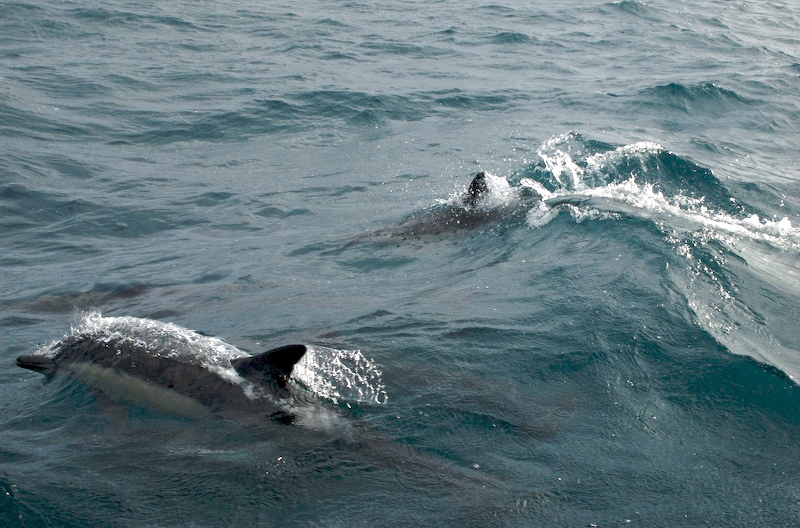
Dolphins close to the boat On the second leg–something snapped. Or popped. Or awoke. In all of us. Maybe it was the adrenaline from the start. Or, more likely, it was pulling into the Bahia de Tortugas with 60 boats from the fleet already waiting for us. I, for one, thought a we pulled into the last anchorage, “Wait a minute. We are down here on a RACE boat–with no insulation, exactly ZERO exquisite staterooms, with a two-burner stove and a one-holer toilet seat for which we fabricated a CURTAIN to give us the illusion of privacy, and weighing roughly less than the diesel, water and provisions you are carrying on-board . . . and, YOU beat us?”

Regardless of what the motivation was, each of our little-racers-within awoke from their nap, and they were hungry. No motor. Spinnaker through the night. No set the spinnaker to a conservative setting and forget it. This was war–or, better, this was a RACE! There isn’t really a trophy, per se, but we wanted an illusionary one. We wanted “bragging rights” which has its own HUGE currency in the superstitious, over-indulgent, beer-swilling, story-telling world of sailors. And, race we did.

The winds picked up and were blowing around 25 knots during the end of the first day, and Nathan hand-drove for hours–keeping the boat on the edge to drain every ounce of speed out of her . . . because Marishanna shines in these conditions: downwind, big seas, and 25 knots of breeze. If it wasn’t for the warmer water, she might have thought she was at home in San Francisco.
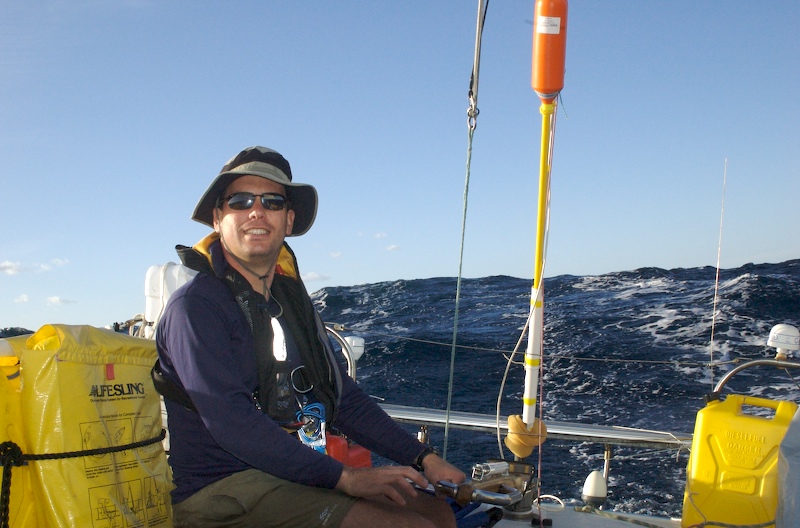
Nathan driving With the spinnaker up and sailing downwind, a racing sailboat can do magical things. If the driver knows what he/she is doing, they feel the wave approaching (there is also a rhythm to it), and they turn the transom of the boat to sit firmly on the wave, and for a few brief moments, the hull partially pulls out of the water and basically “surfs” down the waves. By definition, sailboats should only be able to go a certain speed calculated by the length of the hull. In these brief moments, however, a light, fast, raceboat with a large spinnaker sail up, properly-designed stern, a powerful wave, and a good driver, and you can reach speeds above your hull-speed (Marishanna’s hull-speed is in the mid-to-high 7 knots).

With Nathan driving and the conditions right, we peeled off consistent 10′s–for awhile, doing it with almost every wave. We hit some pretty regular 11′s and saw numbers as high as 15 knots. And, that is how you win races.

Sailing to Bahia Santa Maria was about 280 nautical miles. We ripped off the first 180 miles in about 20 hours, and as the wind died from 25 knots to 15 knots and down to 10knots, we continued to drain every ounce of speed we could get from the boat.
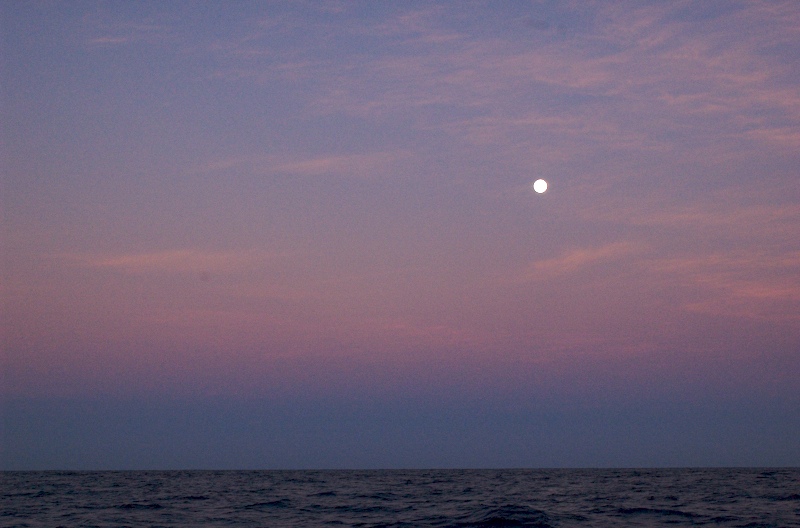
Moon Rise in the Pacific Ocean Somewhere in the early hours of the morning (around 4am), a bit more than 2 days after we started, we crossed the finish line. We weren’t the first to arrive, but at least we were respectable (in the top 20) and, had our pick of the anchorages.

And, yes, the green boat was already there . . . .

  • Share/Bookmark

One response so far

Oct 26 2009

Almost to the Border

And, were off! A few more minutes to the Mexican border. Weve got the spinnaker up, and we are sailing.

More soon!

  • Share/Bookmark

One response so far

Oct 26 2009

The Boat Leaves at 9am

My apologies for the lack of updates–there are some wonderful and crazy stories to tell from the delivery leg.

But, right now, we have 40 minutes until the boat departs for the starting line.

Pictures and stories to come–I promise!

  • Share/Bookmark

No responses yet

Sep 07 2008

Skip Allan’s Decision to Scuttle Wildflower

Published by Tim under Boats,Sailboat Racing,The Adventure

I received this in an email from the Sailing Club–I think it is Skip Allan’s recounting of his decision to scuttle his beloved boat, Wildflower on the return trip (after winning the Single-handed division of the Transpac).  It is heart-wrenching . . . .

On Saturday, 8/23, 10 days after leaving Hanalei, we were halfway home to Santa Cruz with 1190 miles to go. We had passed the Pacific High, and were running in the Westerlies at latitude 38-38 x longitude 147 -17. So far, the passage had been going well, my sixth return passage from Hawaii aboard WILDFLOWER. But an ominous note on the thrice daily weather fax charts was the notation “GALE” between our position and the Pacific Coast.

I began to plan for this possible gale by increasing latitude, slowing down, and closely monitoring projected GRIB files out to 144 hours. It appeared from all forecasts that we needed to slow down at least 48 hours to let the gale ahead abate. However, it is against my instincts to try and slow a boat down, and so with difficulty I reefed the main and dropped the jib in 8 knots of wind, reducing speed to a sedate 3.5 knots in smooth seas.

On Wednesday, 8/27, the morning GRIB file showed the area of most wind ahead was between 124 and 128 degrees, with no weather abatement until at least Monday, 9/1 earliest. Dwight on NA NA, 450 miles ahead, had reported gusts of 42.5 knots from the north between latitude 127-128 and having to run off under storm jib 80 miles. NA NA reported 20 foot seas the previous night near 37 x 124-30. I hoped that WILDFLOWER, by being at the latitude 40 degrees, would allow us to run off 180 miles to the latitude of Santa Cruz, should conditions worsen.

On Friday, 8/29, at sunset near 40 x 130, conditions began to rapidly deteriorate. I changed to the #4 (75% short hoist) and storm staysail, dropping the main completely.

The following day, Saturday, 8/30, with Santa Cruz 365 miles on a bearing of 095 T, we were having to run off due south (180 T) in winds 30-35 knots. By 1530, the sail combination proved too much, and I dropped the #4, flying the storm staysail (39 sq.feet) and towing a 30” diameter metal hooped drogue. It was uncomfortable, windy, and rolly that night, with the cockpit filling about every five minutes, and the boat being knocked down to 70 degrees at least half a dozen times. WILDFLOWER’s shallow cockpit and oversize drains allowed full drainage in about 90 seconds, and this was not a problem.

The electric Auto Helm 1000+ tiller pilot was doing an amazing job steering, as it was being continuously drenched, even submerged. The Sail-O-Mat windvane was useless preventing or correcting breaking wave induced broaches and I retracted its oar to avoid fouling the drogue rode.

On Sunday, 8/31, the wind was 30-35 with a confused wave train from the NW, N, and NE. At 0915 I winched in the drogue to change from a hi-tech spinny sheet to stretchy nylon anchor line. Unfortunately, I found the drogue had split, and was no longer effective. I deployed my spare drogue, but without a metal hoop, it would periodically collapse astern in a breaking crest.

At noon, it looked like the gale was lessening. I left the safety of the cabin, and with two safety harnesses affixed to the windward rail, began to hand steer eastward on a reach with the #4. It was mogul sailing at its best, having to radically bear away to avoid hissing 8-12′ breaking crests on the top of 15-30 foot seas.

At sunset I again went below with the Auto Helm tiller pilot continuing to steer nicely under #4 jib. Not long after, the wind came on to blow from the NNW, and the seas began to build further. That night I stayed suited up below with full foulies, headlamp, and harness, ready to dash out the hatch and take the tiller if the autopilot failed, and we subsequently rounded up. In addition, I dropped the storm staysail, as we were running too fast at 6-9 knots. Under bare poles DDW, the speed was better at 5-7 knots.

What followed ultimately played into the following day’s events. During the long night, my third in this particular gale, breaking crests would poop the boat about every five minutes, filling the cockpit and surging against the companionway hatch boards. Even though I had gone to lengths for many years to insure fire hose watertight integrity of the companionway hatch, I found the power of the breaking wave crests slamming the boat would cause water to forcefully spray around the edges of the hatchboards and into the cabin.

During the long wait for daylight, I had more than enough time to ponder what might happen if the autopilot was damaged or was washed off its mount. I had two spare tiller pilots. But it would take several minutes, exposed in the cockpit, on my knees, to hook up a replacement in the cockpit, on a dark night, when the boat was being periodically knocked down and the cockpit swept.

In addition, I pondered the fate of the DAISY that was lost in the spring’s Lightship Race, when presumably a large breaking wave crushed and sank DAISY. I also reminded myself I was responsible for not only my own life, but was also a family care giver at home.

There was no doubt that if WILDFLOWER’s tiller pilot was lost that we would round up and be at the mercy of these breaking waves, some of which I estimate to be in the vicinity of 25-35 feet, and as big as I hadn’t seen since the ’79 Fastnet Race storm on IMP.

The anxiety and stress of this night, with the whine of the wind in the rigging, the wave crests slamming into the hatch boards, and the 70 degree knockdowns that would launch me across the cabin, created serious doubts that we could continue this for another night, much less the 3-4 days the conditions were expected to continue.

The boat was fine, and had suffered no serious damage yet. My physical health was OK, but I could see with minimum sleep that my decision making could be beginning to be compromised

At 0715 the following morning, Monday, 9/1, I Sat phoned my long time sailing friend, ham radio contact, router, navigator and weatherman, Joe Buck in Redondo Beach. Joe and I had maintained 2x/day ham radio schedule since leaving Hanalei, and he had instant internet access to all forecast weather and wave charts. I explained the current situation to Joe: that I’d had a difficult night, and wasn’t sure I could safely continue. Joe’s weather info had the highest wind and wave on my current drift southward continuing for at least another three days, with continuing gale force winds and 18-22′ significant wave height.

I asked Joe for help in some difficult decision making I had to do. First, would he phone San Francisco Coast Guard Search and Rescue (SAR), and query what the protocol is for asking for assistance, all the while making sure the CG understood I was not in trouble and was not asking for help at this time. (Coast Guard NMC Pt. Reyes, Kodiak, and Hono were not answering my radio calls on their published safety and working 4, 6, 8, and 12 mg frequencies, both simplex and duplex.)

Joe called back an hour later (0830) on ham radio 40 meters and said that Lt. Saxon at SAR reported no military assets within 200 miles or 20 hours, that WILDFLOWER was 200 miles beyond helo range, but that there was an inbound container ship TORONTO coming in my direction at an undetermined distance.

Joe helped me to understand if the boat were lost, I would likely be lost also. But that if I left WILDFLOWER proactively, that only the boat would be lost. I told Joe of my hesitation of putting my life in the hands of a possibly foreign crew on a big commercial ship during a transfer off WILDFLOWER in these conditions, especially at night. We agreed that a decision had to be arrived at soon, before 1130, and before TORONTO passed by.

I spent the next hour, sitting on the cabin sole on my life raft, debating whether to ask for assistance in leaving my beloved WILDFLOWER. “FLEUR” was my home, consort, and magic carpet that I had built 34 years ago. I cried, pounded my fist, looked out through the hatch numerous times at the passing wave mountains, remembered all the good times I had shared with WILDFLOWER. And came to a decision.

At 1115 I called Joe back and told him to again call Lt. Saxon at SAR and inform her that I was asking for assistance. Joe called back and informed me that TORONTO was 5-6 hours away, and that SAR needed to hear from me directly as to my request.

At 1200, like a gopher popping out of its hole, I slid the hatch open to get a clear Satphone signal, and called SAR. Lt. Saxon already knew my details and position, and only asked “what are you requesting?” I replied, “I am asking for assistance to be removed from my boat.”

We kept the conversation short and to the point, due to my exposure topsides with the Satphone. She said the MSC TORONTO would be requested to divert, that I was not to trigger the EPIRB, but that I was to take the EPIRB with me when I left WILDFLOWER. Contrary to published reports, at no time did I call “PAN PAN,” and no com schedule was kept with the Coast Guard, although I did check in with Joe every 30 minutes on ham radio.

Lt. Saxon also said that if I left my boat, she would be considered “derelict” and broadcast as a hazard to navigation. I assured her I would not leave my boat floating.

An hour later, at 1300, WILDFLOWER’s AIS alarm rang. MSC TORONTO was showing 30 miles away, and closing at 23.4 knots from the south west. I had to do some fast planning.

But with no idea how the transfer would be made (jump, swim, climb, hoist?) I didn’t know what I could pack into my bag, bags, or backpack. I decided on my documents, wallet and and passport, laptop, camera, cellphone and sat phone, logbook, EPIRB and a change of clothes and shoes. All this I bagged into waterproof bags. And in a moment of whimsy, decided to try and offload the two Single Handed Transpac perpetual trophies, as they had 30 year historical and sentimental value to our Race.

At eight miles, the captain of the MSC TORONTO rang on the VHF. He spoke perfect English, and as I had a visual, directed him to alter 20 degrees to starboard to intercept. He explained his ship was over 1,000 feet long, that he would lay her parallel to the waves and make a lee at a forward speed of Slow Ahead (6 knots).

The captain also explained that I would board his ship from a rope ladder that led to the pilot’s door, on the aft starboard side. I asked if he could slow to a speed between 3-4 knots, and he willingly agreed to try. At five miles, a sharp eyed lookout on MSC TORONTO sighted WILDFLOWER ahead. But MSC TORONTO’s radar and the rest of her bridge crew did not sight WILDFLOWER until 2.5 miles under these conditions.

At 1415 hours, one of the world’s biggest container ships was bearing down on WILDFLOWER, less than five boat lengths (125 feet) dead ahead, the huge bulb bow scending 20 feet and making a five foot breaking wave. With my heart in my throat, I motored down the starboard side of a gigantic black wall, made a U turn, and pulled alongside the pilot’s door and rope ladder.

The crew threw a heaving line, and in the next five minutes we transferred three bags. Knowing I was next, I jumped below decks, said a final quick goodbye, and pulled the already unclamped hose off the engine salt water intake thru hull.

Back on deck, I reached for the bottom rung of the Jacob’s Ladder, which was alternately at head height, and 10 feet out of reach, depending on the ship’s roll. I grabbed hold, jumped, and did a pull up onto the ladder, and climbed up, wearing a 15 pound backpack with my most valuable positions and EPIRB.

At 1429 hours, on Monday, 9/1, 2008, at position 35-17 x 126-38, the MSC TORONTO resumed its voyage to Long Beach, leaving WILDFLOWER alone to bang and scrape her way down the aft quarter of the ship and disappear under the stern. I watched, but could barely see through my tears.

Four hours and 100 miles SE of where I left WILDFLOWER I was on the bridge of MSC TORONTO watching the anemometer True Wind Speed graph continuing to register 32-35 knots. From 140 feet off the water, the swells below still looked impressive, and the ship was rolling enough to send spray above the top containers on the foreward part of the ship

For the next 24 hours aboard MSC TORONTO (1065′ LOA, too wide for Panama) I was treated with the utmost kindness and compassion by Capt. Ivo Hruza and his 24 man crew. We stood watch together, ate together, told stories, viewed family photo albums, discussed the world situation, toured the ship and engine room (12 cylinder, 93,360 horsepower diesel). By the time we came down the Santa Barbara Channel and docked at Long Beach, I felt a part of this happy crew of 6 nationalities. I could not have been assisted by a better or more professionally manned ship.

On Tuesday afternoon, after clearing customs and immigration aboard, I shook hands with each and every crew member. And descended the gangway alone, to meet Joe, sister Marilee, and begin New Beginnings.

I will never forget WILDFLOWER. She took a beating in this gale. She never let me down, and took me to amazing places, where we met wonderful people and made new friends. In this time of loss, a most wonderful thing is happening: many loved ones, friends, interested parties, and people I’ve never met are closing a circle of love around the mourning and celebration of WILDFLOWER.

Time will heal a broken heart. I look forward to seeing everyone at Carla and Mark’s. I apologize in advance if at times I have to look away and wipe my tears.

Treasure Each Day,

Skip

  • Share/Bookmark

2 responses so far

Jun 12 2008

Roger Stone – Fair Winds and Following Seas

Published by Tim under Sailboat Racing

My heart goes out for the loss of a fellow sailor, Roger Stone.  He was the Safety Officer aboard the Texas A&M team boat, the Cynthia Woods, and lost his life while saving the lives of two sleeping crew members.  This tale resonates with me because it reminds me of races and experiences that I have had sailing off-shore from San Francisco.

The crew of the Cynthia Woods, a 38 foot racer cruiser built by North Carolina-based Cape Fear Yachts, were doing everything right.  They were sailing on an appropriate sailboat for their regatta from Texas to Veracruz.  They had safety gear aboard (including the flashlight that rescuers would spot to rescue them), and their vessel was inspected as recently as April.  They were a good, cohesive team, and stuck together during a crisis—five members floating 26 hours in the Gulf of Mexico together with only four lifejackets.

This resonates with me because I have metaphorically sailed on that sailboat.  In San Francisco, I have been part of the crew on about a dozen racing sailboats.  They have all been recently inspected,  appropriately sized and provisioned for the conditions, and maintained the proper safety gear aboard.  For the most part, they have been filled with exceptional sailors.

In the weeks to come, there is going to be a major inquiry into what happened.  The boat builders are going to be held accountable, or the Captain, or the inspector from the boat yard who inspected the keel bolts last April.  We are a blood-thirsty culture, and have grown to possess our own insatiable desire for vengeance.  It will be another media spectacle–a modern-day legal witch-hunt.

The focus should, in my opinion, remain on Roger Stone.  He was the hero sailor who was there when the accident happened.  He woke the two sleeping crew members and pushed them through the hatch to safety—thinking about himself last.  He accepted the position of safety officer aboard his ship in both title and spirit, and when a problem arose, he fulfilled his duty.

Let the lawyers and the media feast upon their scraps and turn this into a series of articles on quality standards in boat builders or court cases where we prosecute ship yard employees for negligence.

Roger Stone’s selfless act of heroism IS the story.

Fair winds and following seas.

  • Share/Bookmark

No responses yet

May 19 2008

Stone Cup: Day Two

Published by Tim under Beneteau,Sailboat Racing

Some choices are easier to make than others . . . and, this one was absolutely clear: I need to look for another boat.

The second day of racing was pretty good. I was mentally prepped and ready for the racing. I was also better rested, no alcohol in my system from the night before, and had eaten better–wanted to eliminate that from my sailing performance altogether. I worked the bow and another racer from another boat I sailed on was working mast–and, he is a good sailor.

The first race in the IRC Division was a shorter race with 3 full sausages around the course. We had a very clean foredeck the entire race: good hoists and douses. We had one issue when the entire boat had prepared for a windward douse and literally, in the last second, the owner called out “Leeward douse!”

I am not sure if he wasn’t able to drive for a windward douse, or if he just plain forgot, or what–but, of course, we had a kite flying out of the back of the boat, lost some time, and recovered unscathed. We may never know what happened, but 8 out of 9 people knew windward douse–unfortunately that ninth person was driving.

The second race started well. The foredeck worked through the 10 minutes of lunch changing headsails for the changing conditions. The winds were holding above 20 knots/hour and gusting higher. I also cleared the gear at that time and re-checked everything.

Once the second race started, we made it to the windward mark, set the pole and had a good hoist–although the we got the final word to t-up the spinnaker about 100 yards from the mark. We gybed a couple of times, and started to talk through the leeward rounding and all was going well, until . . . .

The very next gybe, the lazy spinnaker sheet had come loose and wrapped itself around the jaws of the pole. We had lassoed it around the guy, but there had been some tension on it from the back of the boat and it pulled loose.  When we tripped, it held the pole right in place. The owner of the boat took this race off, and our helmsman is a superior sailor of excellent skill. He saw it happen and eased the boat. As I went to correct this, he thought I was fixing it one way, and I was fixing it the other way.

The result was a REALLY ugly wrap–like picture-worth of the “Now That’s Ugly” contest on Sailing Anarchy (although we did not tear the spinnaker). A couple of crew members came forward to help secure the spinnaker, and we headed in to port.

By this time, the owner had come up from down below and was looking for a scape-goat. And, he picked me. It was relatively soft, but in a sweet and diminutive tone, told me that I was ready for the “light wind” racing and not this heavy stuff.

He did not try to reconstruct what happened. When the trim team said that the foredeck was not getting the information in enough time to act upon it, he did not listen. When the helmsman said that it was a result of mis-communication–he was helping me fix it one way, and I was fixing it the other–he did not listen. In fact, I don’t think he even knew what happened.

And, that is okay. He owns the boat and can run it however he likes, but I do not want to sail with him. Snap decisions cause mistakes. Lack of communication cause mistakes. And, mistakes happen on every boat. Crucifying me for those mistakes is foolish and counter-productive. I am certainly willing to take my share of the blame–but, shouldering all of it is a bit much.  It simply creates a foredeck that is hostile towards the cockpit and a cockpit that is hostile towards the foredeck.  Not exactly a great definition of teamwork . . . .

The larger issue, however, is that the boat owner did not see or understand what happened. He has made his decision blindly, without the information. Sailing like that is how people get hurt–and, it might be me. So, this weekend, and all of the incidents led me to my decision: I am looking for a new boat to race.

Got bowman?

  • Share/Bookmark

No responses yet

May 19 2008

Terms: Windward Douse

There are many ways to do everything on a boat, and some better serve the situation than others.  When dousing the spinnaker, the windward douse is another tool in your bag of tricks.

The name holds the clues to what differentiates this douse from a leeward douse–what side of the boat your are using to bring down the spinnaker.

Here are the steps:

  1. When ready, have a crew member come forward (or the crew member working the mast can do this) and hold the working guy–which is on the windward side.
  2. Trip the spinnaker pole and drop the pole to the foredeck.
  3. At this point, the driver is starting to turn to windward.  Grab both clews and pull/feed it right into the open hatch.  The wind will push it right down the open hatch.

It is a pretty slick way to get the spinnaker down quickly.  One guy on board suggested that you grab both ends and simply sit down.  I presume that this saves your arms and the force starts the descent process of the sail and assists in starting the collapse of that big sail.

  • Share/Bookmark

No responses yet

Next »